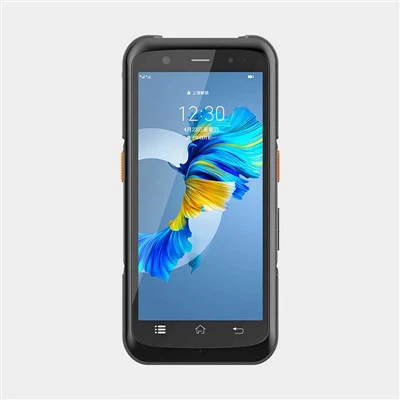
As a PDA device supplier, I'm often asked about the various functions of our devices, and one that comes up quite frequently is the calculator function. In this blog post, I'll guide you through how to use the calculator function on a PDA device effectively.
Understanding the Basics of the Calculator on a PDA
Most PDA devices come equipped with a built - in calculator application. This calculator is similar to the ones you find on smartphones or traditional calculators, but it has the added advantage of being integrated into a device that can also perform other tasks such as barcode scanning and data collection.
When you first open the calculator on your PDA, you'll typically see a standard layout. There are number buttons from 0 - 9, basic arithmetic operation buttons like addition (+), subtraction (-), multiplication (*), and division (/). There's also a decimal point button (.) for working with non - integer numbers, and an equals button (=) to get the result of your calculation.
Simple Arithmetic Calculations
Let's start with the most basic use of the calculator: simple arithmetic. Suppose you want to add two numbers, say 25 and 37. Here's how you do it:


- Open the calculator application on your PDA.
- Press the number 2, then 5.
- Press the addition button (+).
- Press the number 3, then 7.
- Press the equals button (=). The calculator will display the result, which is 62 in this case.
For subtraction, multiplication, and division, the process is similar. For example, if you want to multiply 12 by 8:
- Open the calculator.
- Press 1, then 2.
- Press the multiplication button (*).
- Press 8.
- Press the equals button (=). The result will be 96.
Working with Decimals
The calculator on your PDA can handle decimal numbers as well. Let's say you want to divide 5.5 by 2.2:
- Open the calculator.
- Press 5, then the decimal point button (.), then 5.
- Press the division button (/).
- Press 2, then the decimal point button (.), then 2.
- Press the equals button (=). The result will be 2.5.
Memory Functions
Many PDA calculators also have memory functions. These can be very useful when you're performing a series of calculations and need to store intermediate results.
- Memory Store (M+): This button allows you to store the current result in the calculator's memory. For example, if you've just calculated 3 + 4 and the result is 7, pressing M+ will store 7 in the memory.
- Memory Recall (MR): This button retrieves the value stored in the memory. So, after storing 7 in the memory using M+, you can press MR at any time to get 7 back into the calculation.
- Memory Clear (MC): This button clears the value stored in the memory. If you no longer need the value that was stored, you can press MC to clear it.
Using the Calculator in Business Scenarios
As a PDA device supplier, I know that our customers often use these devices in business settings. For example, in a retail store, the calculator can be used to calculate discounts. Suppose a product originally costs $50 and there's a 20% discount. Here's how you can calculate the discounted price using the calculator on your PDA:
- First, calculate 20% of 50. Press 5, 0, then the multiplication button (*), then 2, 0, then the division button (/), then 1, 0, 0, and finally the equals button (=). The result is 10.
- Then, subtract this discount amount from the original price. Press the subtraction button (-), then 1, 0, and the equals button (=). The discounted price is $40.
In a warehouse, the calculator can be used to calculate inventory quantities. For instance, if you have 5 boxes of a product, and each box contains 24 items, you can calculate the total number of items. Press 5, then the multiplication button (*), then 2, 4, and the equals button (=). The total number of items is 120.
Advanced Calculations
Some PDA calculators also support more advanced functions such as square roots, percentages, and trigonometric functions.
- Square Root: To find the square root of a number, say 16, open the calculator and look for the square root button (usually denoted as √). Press the square root button, then 1, 6, and the equals button (=). The result is 4.
- Percentages: We've already seen how to calculate a percentage in the discount example. But you can also use percentages in other ways. For example, if you want to find out what percentage 15 is of 60, press 1, 5, then the division button (/), then 6, 0, then the multiplication button (*), then 1, 0, 0, and the equals button (=). The result is 25%, meaning 15 is 25% of 60.
Compatibility with Other PDA Functions
One of the great things about using a calculator on a PDA is its compatibility with other functions of the device. For example, if you're using a Handheld Scanner Android to scan barcodes in a store, and you need to calculate the total cost of the scanned items, you can easily switch to the calculator function. After scanning each item, you can enter its price into the calculator and add them up.
Similarly, if you're using a Handheld PDA Scanner in a logistics operation, you can use the calculator to calculate shipping costs based on weight, distance, and other factors.
If you're in the business of inventory management and using a PDA Barcode Scanner, the calculator can help you calculate reorder points, stock - to - sales ratios, and other important metrics.
Conclusion
The calculator function on a PDA device is a powerful tool that can be used in a variety of scenarios, from simple arithmetic to more complex business calculations. Whether you're in retail, logistics, or any other industry that uses PDA devices, mastering the calculator function can improve your efficiency and accuracy.
If you're interested in purchasing our PDA devices or have any questions about their features, including the calculator function, we encourage you to contact us for a procurement discussion. We're here to help you find the right PDA solution for your business needs.
References
- General knowledge about PDA device functions and calculator operations.
- User manuals of various PDA devices.